In Australia the requirements for a SWMS in facade cleaning are dictated by the method of work, any risk of falling and if it is to be classed as High-Risk Construction Work. The law mandates a Safe Work Method Statement for high-risk construction of a certain kind, such as where there is a possibility of a person falling in excess of 2 metres. This document has to lay out the work, make hazards plain, put in place risk controls and demonstrate the protection of workers.
Thomas Ashbury here. Over the years I have put pen to paper on the sort of practical matters that come up when a nice promise is put up against an inconvenient fact of life. Facade cleaning is no different. From the street a building can appear quite orderly but the business of making the glass spotless may call for rope access or scaffolding, not to mention chemicals, wind, traffic, pedestrians and moving plant. One’s paperwork had better be in keeping with what is actually happening, otherwise it is nothing more than a logo on some office decoration.
The Function Of A Facade Cleaning SWMS
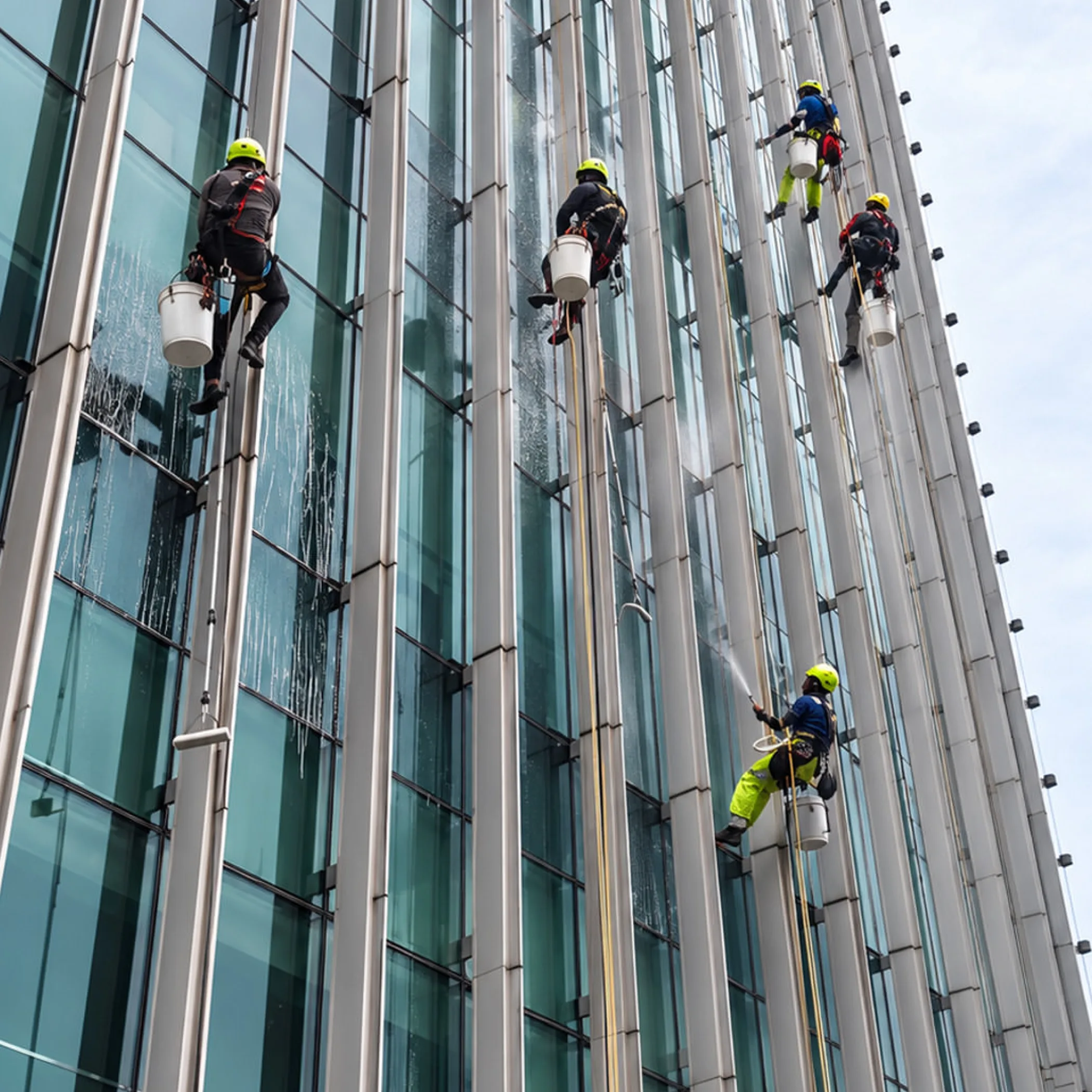
To put it simply, a SWMS will tell you how a particular job is to be done in safety. It should link the way the cleaning is to be carried out to the site hazards and the controls in place, as well as what is to be done in the event of trouble.
It is not a risk assessment lifted from another project, nor a training certificate or a general policy. A SWMS for a building facade should be of the site. Take into account the height of the structure, the materials, the weather, the roads and public areas in proximity, the equipment, including high rise exterior access methods, and the chemicals being put to use.
A Question Of Site
You will find the risks are not the same at a low-rise retail outlet on an industrial estate as they are in a tower in Perth, Melbourne or central Sydney. The latter could mean dealing with tram lines, delivery trucks, tenants, balconies, wind tunnels and a host of pedestrians below.
Your SWMS must cover the precise work and access arrangements. It is also there to say who has authority over the site and can halt proceedings, and to set out the lines of communication with the public, emergency services and building management.
Legislative Necessity
High-Risk Construction Work cannot commence without a SWMS. Australian WHS frameworks see construction work with a fall risk of over 2 metres as one of the triggers. If the regulations of the state or territory so dictate, facade cleaning is included.
How the work is defined and which jurisdiction one is in will determine the legal standing. A PCBU would do well to check the codes and regulator guidance before starting. There is national direction from Safe Work Australia on fall prevention and working at heights; for enforcement and information at state level one looks to WorkSafe WA, WorkSafe Victoria or SafeWork NSW.
Is It Construction Or Just Cleaning?
Being above ground does not in itself mean a SWMS is needed for all cleaning. The law and the nature of the task and equipment will see routine cleaning handled in a different manner to construction work, though the obligation to manage risk and spot hazards remains.
Should the job entail the installation or removal of building elements, or the use of construction plant with a fall risk of 2 metres or more, then the HRCW cleaning rules are in play. In case of any uncertainty, get some competent advice and put together a SWMS that is an honest representation of the work. Guesswork is not a good way to control risk.
Contents Of The Document
For a safe work method statement to be of any use to a worker in the field it has to be straightforward. It need not read like a novel but it should have the requisite detail to steer one through the important steps and what to do if the situation alters.
The document will name the business and the site, the activity and the supervisors and workers to whom it applies. Also included are the review date and the process for consultation and any updates to the document.
What Is Essential
- Information on the work location, building and access.
- The sequence of the work from set-up to pack-down.
- Hazards be they from falls, objects, plant, electricity, the elements or pedestrians.
- Controls in accordance with the hierarchy, with personal protective equipment coming after the higher-level options.
- Any licences, competency, inspection of equipment and exclusion zones.
- And for emergencies, procedures covering rescue, injury, exposure to chemicals or a failure of equipment.
- There must be a means for worker consultation and sign-off, as well as a procedure to put a halt to work should the controls prove wanting.
- The same goes for incident reporting and how one is to be notified of a notifiable incident; these arrangements need to be in place and reviewed.
The document has to set out in plain terms what the workers will be doing. A directive to “use appropriate controls” is too open to interpretation. It is of more value to have it read: “put in a barricaded exclusion zone under the work face, check the rope system prior to use and stand down if the wind is above the manufacturer’s or equipment limit”, assuming the limits and procedures have been checked for that equipment.
Facade Hazards And Practical Controls
In facade cleaning you have a number of hazards in a single task. A worker could be at risk from a fall, a chemical splash and the public all at once. So the controls cannot be relegated to different parts of a folder, they have to function as one.
It is an error to make height the sole hazard of concern. Between water pressure, wind, fatigue, poor communication, fragile surfaces, glass failure, overhead services and tools on the drop, an otherwise straightforward clean can become a long afternoon.
Common Risks On Site
| Hazard | Possible consequence | Typical controls |
|---|---|---|
| Falls (in excess of 2m) | Serious injury or death | Get rid of the height if you can. Otherwise have edge protection, scaffolding, EWPs, rope systems or other controls in order and see they are compliant and inspected. |
| Falling tools or materials | Injury to any worker, tenant or pedestrian | Controlled material handling, toe boards, exclusion zones, overhead protection and tool lanyards. |
| Wind, rain or lightning | Slips, loss of control, equipment movement or suspension | Have defined stop-work limits and a return-to-work process, and monitor the weather. |
| High-pressure water | Injection or eye injury, surface damage, slips | A SWMS for pressure washing, guarding, PPE, hose management, competent operators and controlled drainage. |
| Hazardous chemicals | Burns, respiratory or environmental issues | Review the safety data sheet, have the right PPE, ventilation and dilution controls, store correctly and be ready to respond to a spill. |
| Vehicles and pedestrians | Collision or injury to the public | Barriers, spotters, signage and delivery times under control. |
Do not lift controls from a template, match them to the job. If there is no room for a worker to put a control in or use it properly then it is of little account however good it may look on paper.
Choosing Safe Access Equipment
For high rise exterior work the building design, the height, condition of the facade, ground space, weather and rescue considerations will dictate the method of access. One wants a method that is reliable for the worker and keeps the public at bay.
Rope access, scaffolding, an elevated work platform, boom or scissor lift and a building maintenance unit are all options but each comes with its own demands in the way of inspection, competency, anchorage and so forth.
Rope Access Requirements
You will need anchor systems and equipment that are compatible, workers who are trained and a rescue plan that is practical. The SWMS is where rigging, pre-use checks, edge and dropped-object controls, communication and the like are to be found, including what is done when a worker is suspended and unable to self-rescue.
Rescue distance is something that can be overlooked. If a worker is in some discomfort or injured, a call to emergency services might not suffice. The plan needs to make clear who does the rescuing, with what equipment and by what means they will get to the person.
Scaffolds, EWPs And BMUs
Only those with the requisite competence and supervision should be erecting or taking down scaffolding. The SWMS should take in foundations, ties, loading, access and any alterations from the weather or other trades.
With an EWP the document should make reference to the operator, ground and overhead conditions, exclusion zones, how to lower in an emergency and what the manufacturer says. A boom and a scissor lift are not interchangeable and to think so is to court problems.
A BMU calls for a knowledge of the permanent access system, the travel path, the controls and any weather restrictions. There should be communication with building management and the worker must be able to stop the unit and know the course of action if it is stranded or the power fails.
Chemicals, Water And Public Areas
These are at the heart of safe cleaning. What is fine for one surface may do harm to another and the runoff can be an issue for those or vehicles below.
Check every hazardous chemical with the current safety data sheet. The SWMS should deal with everything from storage and labelling to decanting, application, disposal and incompatible substances. Workers are to have the SDS to hand and an understanding of the controls, not just put their name to a folder.
Pressure Washing Controls
The SWMS for pressure washing work must spell out the equipment in use, the operating pressure and nozzle of choice, as well as any surface limitations, hose routing and what constitutes a safe distance. It is incumbent on operators to see that the water jet does not come into contact with people, electricals, any glass or facade elements that are fragile or unsecured, and unprotected openings.
Then there is the matter of drainage, overspray, runoff, wet floors and hoses; all of which can make for a slip hazard in short order. The SWMS has to address these and where public access is to be curtailed. Should there be a possibility of water making its way to a tenancy or onto electrical gear, the control plan must have it covered before one pulls the trigger.
Protecting People Below
Plan your traffic and pedestrian management in advance of the equipment turning up. You may need to put in place spotters, signs and barriers, but they have to be positioned to accommodate the footpath, road, loading zone, building entrance and any emergency access.
Do not expect a passer-by to spot a warning sign. Make use of physical separation if you can, secure anything that might be dropped and get with building management over tenant movements, deliveries and the like.
Consultation And On-Site Sign-Off
When it comes to worker consultation, having them put their name to the last page is not enough. Those in the field will see things from a desk that are not apparent, be it a tight landing, a fire exit being crossed by a hose or an anchor cover in disrepair. In putting together the SWMS the PCBU should consult with the workers concerned, lay out the controls prior to starting and have a means for them to voice any issues. A sign-off is confirmation of a discussion, not a way for the business to offload responsibility.
Daily Checks And Changes
Before work is underway the supervisor needs to be satisfied the site is in accordance with the SWMS. Any change in the wind, pedestrian flow, tenants, chemicals or access could mean halting work to go over the document.
- One should check PPE, ropes, harnesses, anchors and hoses before they are put to use.
- Verify the exclusion zone and the route for emergencies.
- Take stock of the weather and any alterations to the building or traffic.
- Be sure the workers know the method and rescue arrangements.
- If the conditions do not bear out the plan, stop and update the SWMS.
It is no good for a SWMS to be sitting in an office inbox while the crew has to rely on memory; it ought to be at hand for workers and inspectors.
Record Keeping And Retention
How long a facade cleaning SWMS is to be kept will vary with the jurisdiction and the project’s associated records. The business would do well to adhere to the regulator’s guidance and WHS rules and file the document with the rest of the training, incident and inspection records.
In the event of a notifiable incident, the relevant records are to be preserved and the state or territory’s notification requirements met. An incident, near miss or failure of equipment can also call for a review of the SWMS.
Be aware that SafeWork NSW, WorkSafe Victoria and WorkSafe WA can have their own administrative demands. There is no national template that will meet every local obligation so check with the regulator for the worksite.
Common Mistakes To Avoid
For the most part, trouble is found where there is a disconnect between the job and the paper work. One will find that a SWMS for building facade cleaning of the generic sort is apt to make note of heights, PPE and chemicals yet leave the access system, public protection or any rescue method unexplained.
Then there is the error of putting PPE forward as the principal control. A helmet and gloves are important but they will not stop a man from going over an unprotected edge. Under the hierarchy of controls, the onus is on the business to look at elimination, substitution, engineering and administrative options before it comes to PPE.
And what of the maintenance staff, the tenants, a delivery driver, a cleaner or some member of the public? They may well have missed the toolbox talk but they can put in an appearance in the risk area all the same. An SWMS worth its salt covers the entire site, not only those in high-vis.
Practical Compliance Takeaway
For a window cleaning SWMS to be compliant in Australia it has to be something you can use, current and to the point. It should set out the start of work, how the facade is to be accessed, the prevention of falls and dropped objects, control of water and chemicals, separation of the public and the handling of an emergency.
Where the job is High-Risk Construction Work, the SWMS is to be put in place and made available at the workplace prior to commencing. Have the workers part of the planning process and see to it the controls are reviewed if conditions warrant it; also check with your state regulator.
I have a straightforward way of testing it: put the SWMS in front of a worker and have him tell you about the first five minutes of the job. A document is doing its part when the response is practical and makes sense on site. Should he say “put on your PPE and be careful”, then it is time for a rewrite and perhaps a billy of tea.
Frequently Asked Questions
Is a SWMS de rigueur for facade cleaning?
Not always. The applicable WHS regulations dictate a SWMS for High-Risk Construction Work. Any fall risk from in excess of 2 metres is enough to trigger one, though local requirements and the nature of the work are factors. The PCBU is still duty bound to control risks even in the absence of a legal requirement for a SWMS.
What of a generic cleaning SWMS?
It can serve as a framework but do not employ it as is. The finished product must be site-specific and take into account the building, the equipment, the weather, the chemicals and any public risks.
Rope access means no SWMS is needed?
Hardly. That is merely a different form of risk control. The SWMS is required to plan the work in a safe manner and address such things as anchors, inspection of equipment, edge protection, competency, communication and rescue.
Who is to sign off on the document?
The business has to see to its preparation and implementation. Workers will be consulted and put their signature to it as confirmation they are clear on the method and controls. But a signature is no substitute for supervision and does not make the worker answerable for risks he cannot control.
A change in conditions?
Then the work in question is to be halted and the hazards reassessed. Be it stronger winds, a blocked route, a new chemical or another contractor at work, update the SWMS and brief the workers before you get going again.